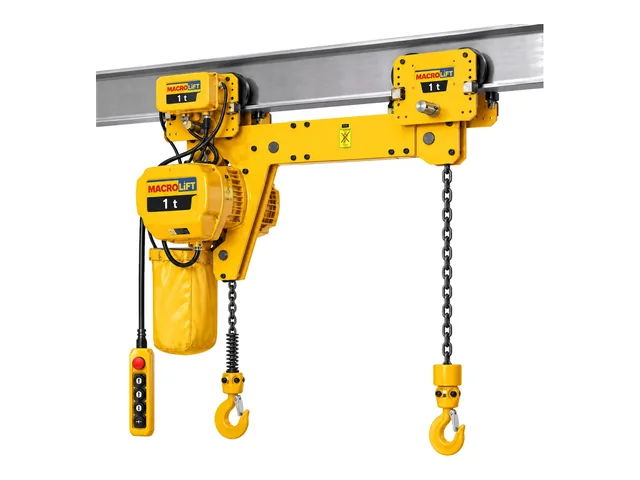
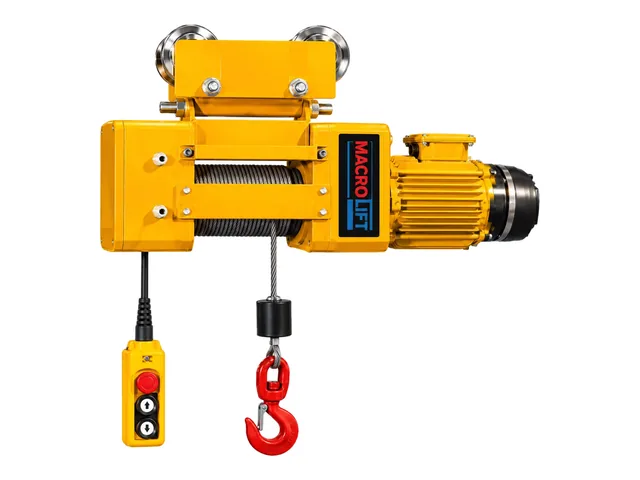
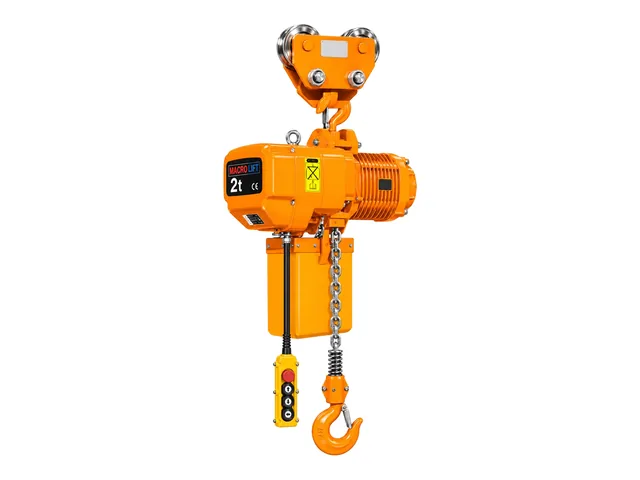
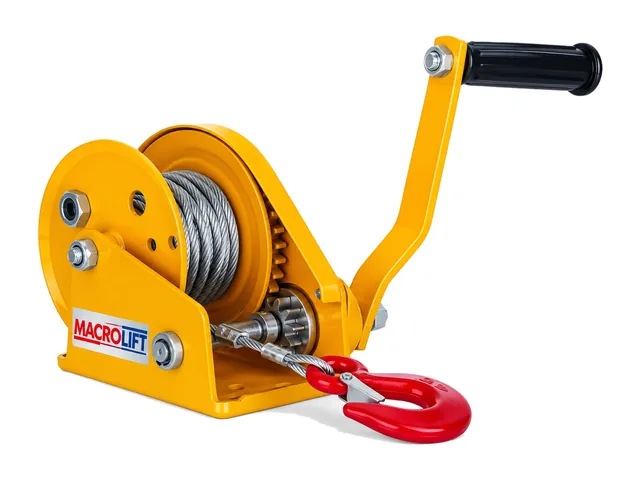
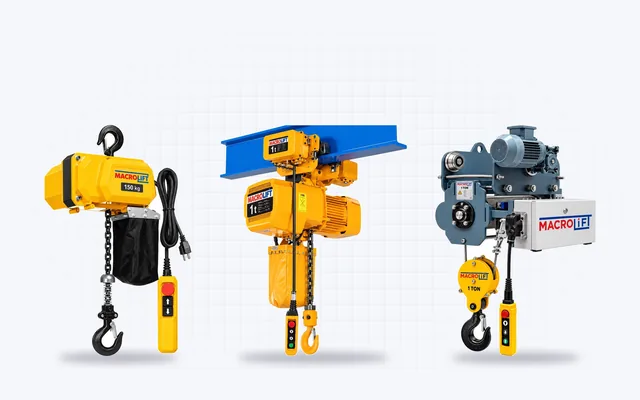
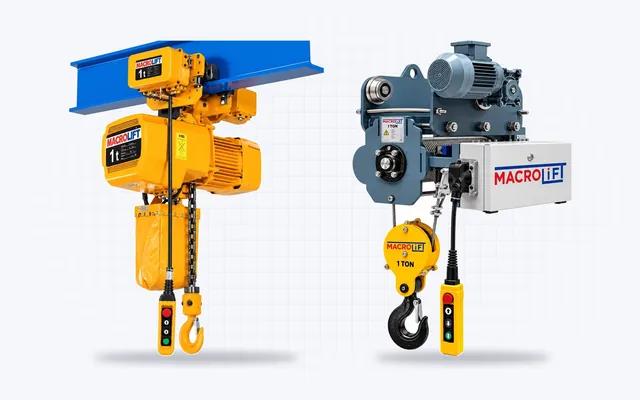
Choosing the right hoist comes down to four values: capacity, lifting height, lifting speed and duty class. Get these four right and the hoist will run without trouble for years, and you will not pay for more hoist than you need. In this article we show how to work out each one, with examples.
Capacity: work out the heaviest load correctly
Hoist capacity is the largest load the hoist can lift safely. It is marked on the rating plate and on the hook block. When you choose capacity, the weight of the part alone is not enough. Everything that hangs on the hook counts as load:
- The heaviest part you will lift
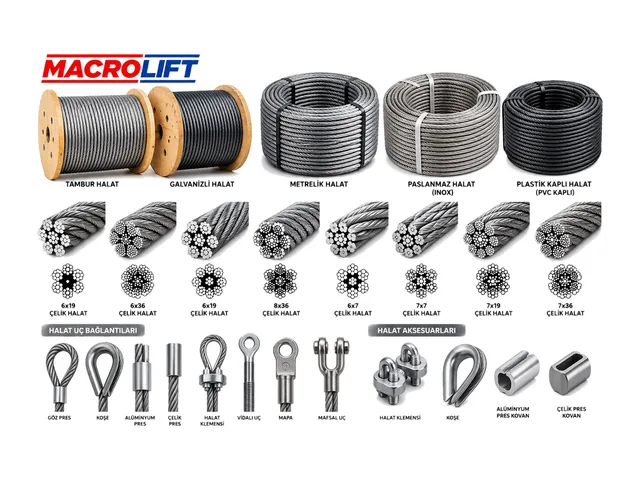
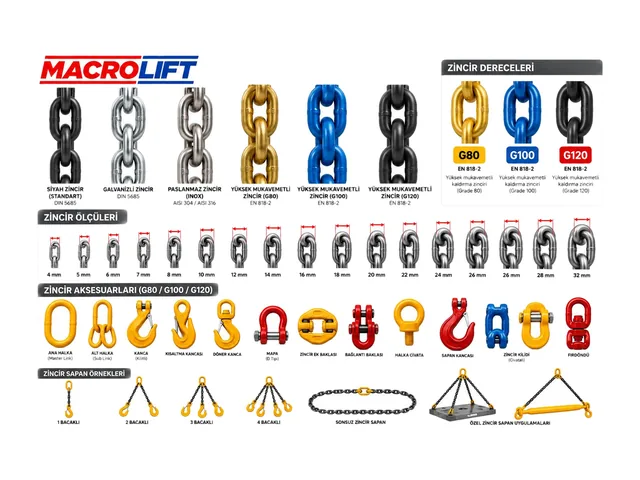
- The sling, whether a chain sling or a wire rope sling
- Below-the-hook attachments (such as a lifting beam, magnet, clamp or drum lifter)
- Any crate, pallet or basket
Example: If you lift a 780 kg mould with a 25 kg chain sling and a 60 kg lifting beam, the load on the hook is 865 kg. A 1 tonne hoist is the right choice for this job. A 500 kg hoist will not lift this load, and a 2 tonne hoist costs more than it needs to and needs a heavier beam.
If you are likely to handle heavier parts in the future, allow for that too. Increasing the capacity later means replacing the hoist, the trolley and often the beam as well.
Never lift a load above the capacity on the rating plate. Load tests are carried out to confirm this capacity. They are not a margin for working above it.
Lifting height: how far does the hook need to travel?
Lifting height is the distance between the lowest and the highest position of the hook. The length of the chain or wire rope is set by it. Measure in this order:
- Measure the distance from the underside of the beam to the floor (or to the lowest point the load will be picked up from).
- Subtract the height taken up by the hoist and trolley. This is also called the headroom (hook approach) dimension and is shown on the product's technical drawing.
- What is left is the longest distance the hook can travel down. If you need to lower the load all the way to the floor, the lifting height must be at least this much.
If you will lower the load onto a platform, into a pit or down to a lower floor, add that depth as well. Choosing more lifting height than you need makes the chain bag bigger on a chain hoist. Choosing less means the load cannot reach the floor.
In areas with a low ceiling, the headroom dimension becomes critical. Chain hoists with a compact body have the advantage here. We compare the two types in chain hoist vs wire rope hoist.
Lifting speed: single speed or dual speed?
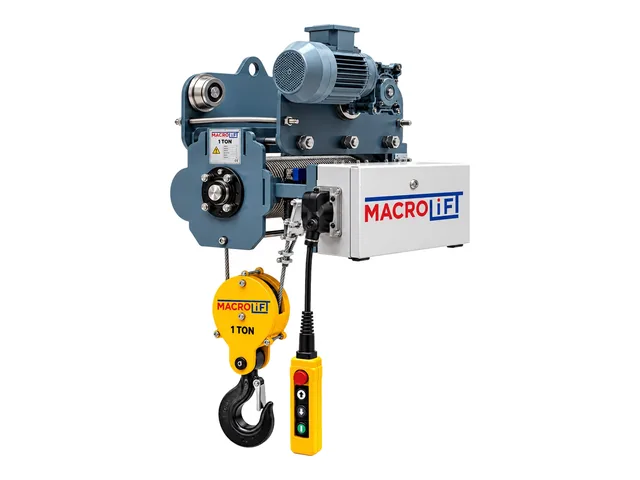
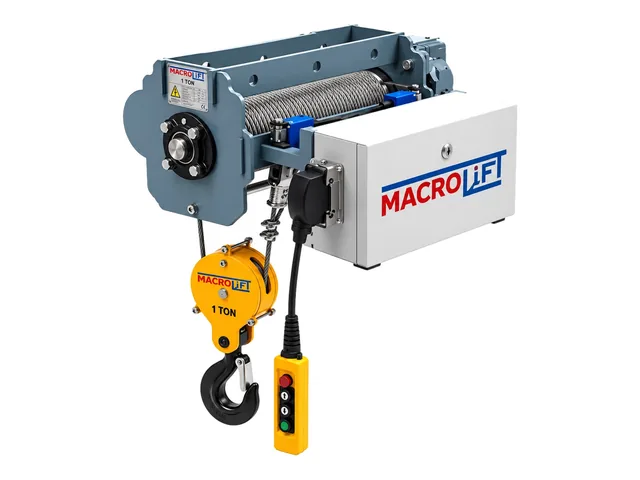
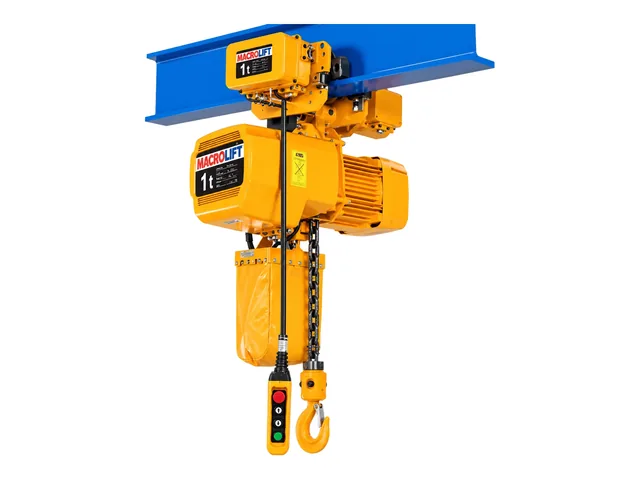
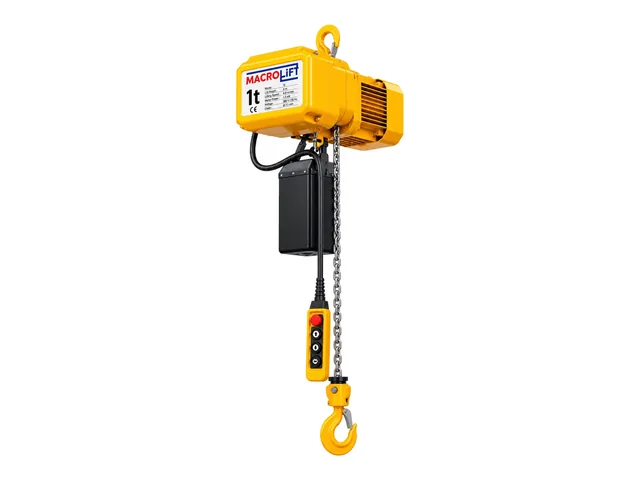
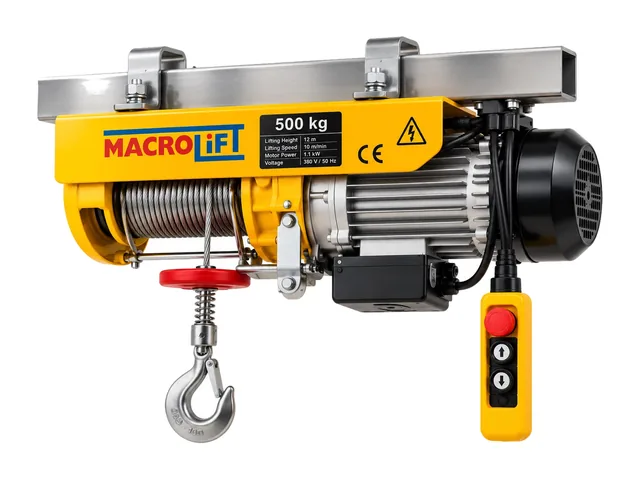
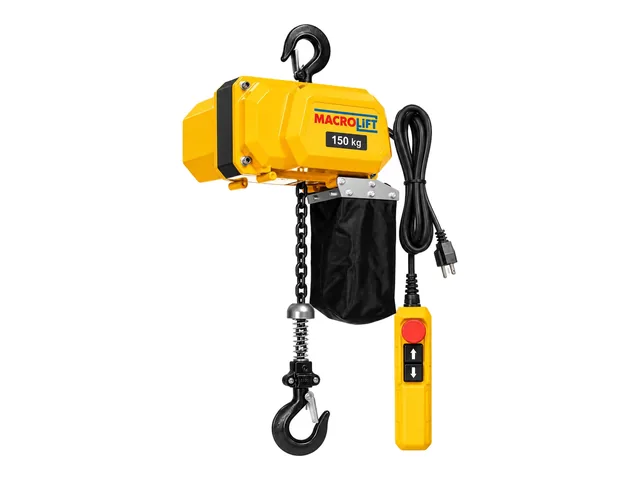
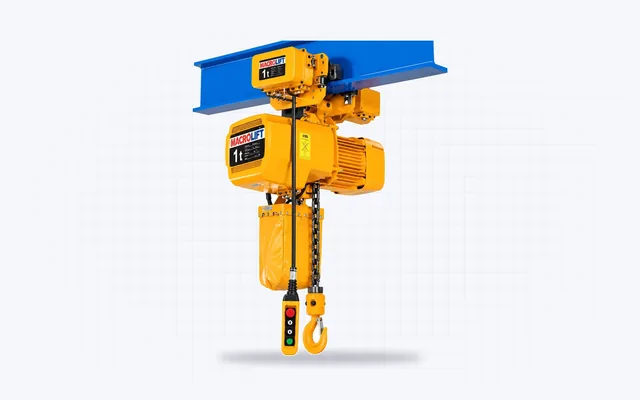
Lifting speed is given in metres per minute (m/min). For example, our 1 t 8 m monorail wire rope hoist lifts at 4.7 m/min and our 500 kg chain hoist lifts at 6.8 m/min.
- Single speed: Enough for most handling work. It is simpler and more economical.
- Dual speed: Lets you lift the load quickly and set it down slowly. This makes a big difference in mould fitting, assembly and precise positioning.
- Variable speed (inverter): The speed is adjusted without steps, so the load starts and stops more smoothly.
Monorail hoists with an electric trolley also have a travel speed. On long runs, travel speed has a clear effect on how long each job takes.
Duty class: how hard will the hoist work?
Two hoists can have the same capacity, but if one runs a few times a day and the other runs across two shifts, they should not be the same hoist. The duty class (mechanism group) shows how intensively the hoist will be used. The FEM 9.511 classification, which is widely used in Europe, looks at how the load weights are spread (the load spectrum) and at the average daily operating time.
Load spectrum
- Light: The hoist mostly lifts small loads and rarely uses its full capacity.
- Medium: The hoist lifts a mix of small, medium and near full capacity loads.
- Heavy: The hoist mostly lifts loads close to its full capacity.
- Very heavy: The hoist almost always works at full capacity.
FEM 9.511 table
In the table below, find your average daily operating time in the row for your load spectrum. The column it falls in gives the minimum class your hoist should have.
| Load spectrum | 1Bm (M3) | 1Am (M4) | 2m (M5) | 3m (M6) | 4m (M7) |
|---|
| Light | Up to 2 hours | 2-4 hours | 4-8 hours | 8-16 hours | More than 16 hours |
| Medium | Up to 1 hour | 1-2 hours | 2-4 hours | 4-8 hours | 8-16 hours |
| Heavy | Up to 0.5 hours | 0.5-1 hours | 1-2 hours | 2-4 hours | 4-8 hours |
| Very heavy | Up to 0.25 hours | 0.25-0.5 hours | 0.5-1 hours | 1-2 hours | 2-4 hours |
The classes in brackets are the ISO 4301 equivalents. Daily operating time is the total time the hoist actually moves (lifting and lowering) during the day. It is not the length of the working day.
Example: In a workshop the hoist mostly lifts loads close to its full capacity (heavy) and runs for about 3 hours a day in total. In the "heavy" row of the table, the 2-4 hour range falls in the 3m (M6) column. This job needs a hoist of at least class 3m. If the same hoist mostly lifted light loads, 1Am (M4) would be enough.
Two things people forget: the beam and the power supply
Even if the hoist is chosen correctly, the system will not work unless the beam and the power supply are suitable. The trolley's wheel spacing must match the flange width of the beam. For example, our 1 tonne wire rope model fits I-beams with a flange width of 80-250 mm. You also need to check by calculation that the beam, its hangers and the building can carry this load. See monorail beam and installation for the details.
Most electric monorail hoists run on 380 V three-phase power. If your site has no three-phase supply, mini chain hoists or mini wire rope hoists that run on 220 V can be an option for light work.
Selection checklist
| Question | Your answer |
|---|
| Heaviest load + sling + attachment | ... kg |
| Lifting height | ... m |
| Beam length and where it will hang | ... m, ceiling / column / existing girder |
| Single speed or dual speed? | ... |
| Load spectrum and daily operating time | ... / ... hours |
| Trolley: electric or manual? | ... |
| Power: is 380 V available? | ... |
Fill in this table and send it to us on WhatsApp, and we will recommend a suitable model. For general information see our guide what is a monorail hoist? For models, see our monorail chain hoists and monorail wire rope hoists pages.